Opus Tokenomics: A Fun Cheat Sheet for Your Claude API Bill
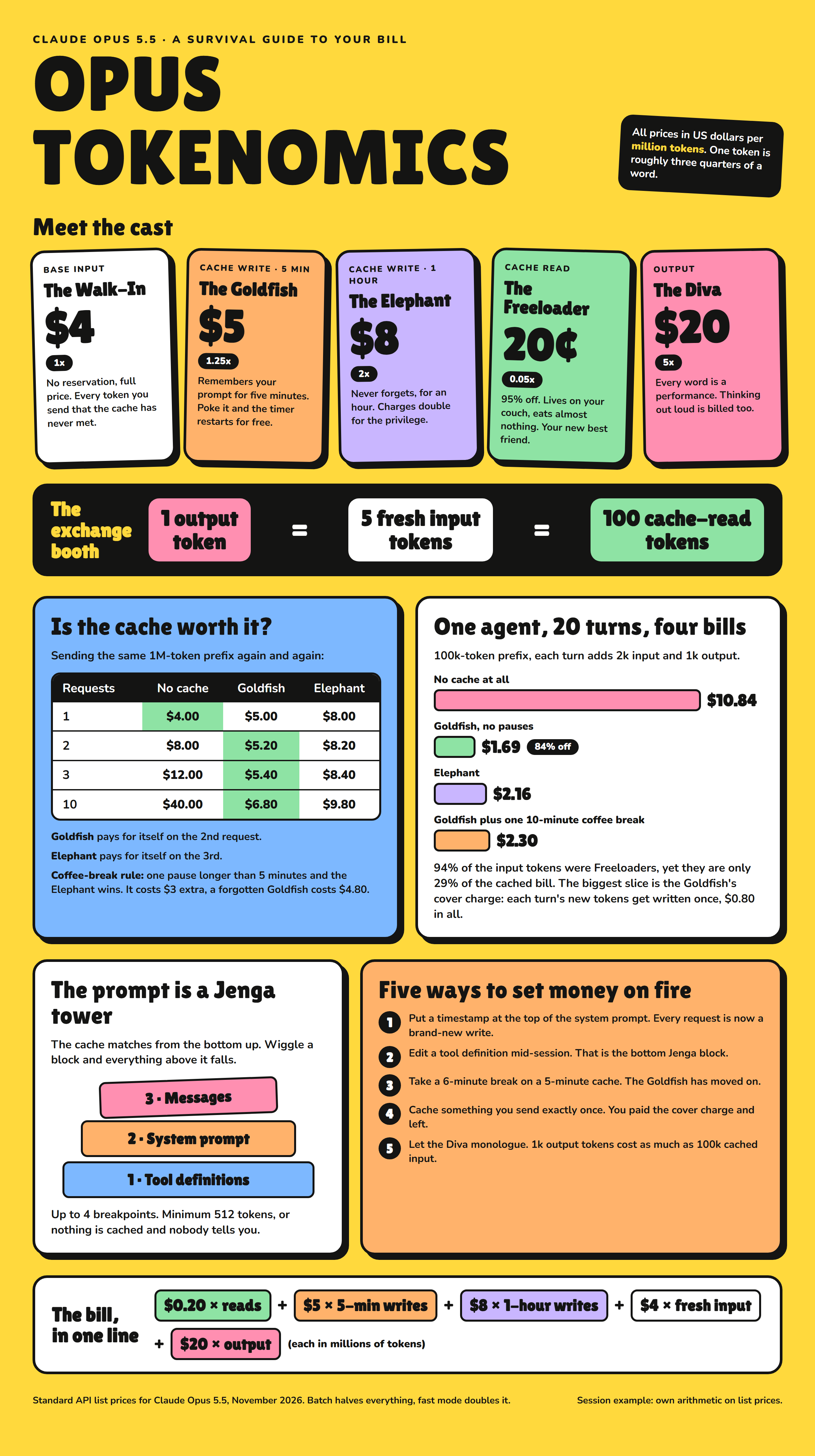
Five characters, one exchange rate and a Jenga tower. Everything you need to read a Claude Opus 5.5 invoice, on one page you can print and pin next to your monitor.
This post represents my private view only. Prices are Anthropic's public list prices as of November 2026. Check the official pricing page before you budget a project on them.
Token prices are easy to look up and hard to feel. "$4 per million input tokens" means nothing at a glance, and the prompt cache adds three more prices with their own rules. So I gave every price a personality and put them all on one sheet. Here it is.
Claude Opus 5.5 · a survival guide to your bill
OPUS TOKENOMICS
All prices in US dollars per million tokens. One token is roughly three quarters of a word.
Meet the cast
- Base input The Walk-In $4 1x No reservation, full price. Every token you send that the cache has never met.
- Cache write · 5 min The Goldfish $5 1.25x Remembers your prompt for five minutes. Poke it and the timer restarts for free.
- Cache write · 1 hour The Elephant $8 2x Never forgets, for an hour. Charges double for the privilege.
- Cache read The Freeloader 20¢ 0.05x 95% off. Lives on your couch, eats almost nothing. Your new best friend.
- Output The Diva $20 5x Every word is a performance. Thinking out loud is billed too.
The
exchange
booth
1 output
token
=
5 fresh input
tokens
=
100 cache-read
tokens
Is the cache worth it?
Sending the same 1M-token prefix again and again:
| Requests | No cache | Goldfish | Elephant |
|---|---|---|---|
| 1 | $4.00 | $5.00 | $8.00 |
| 2 | $8.00 | $5.20 | $8.20 |
| 3 | $12.00 | $5.40 | $8.40 |
| 10 | $40.00 | $6.80 | $9.80 |
Goldfish pays for itself on the 2nd request.
Elephant pays for itself on the 3rd.
Coffee-break rule: one pause longer than 5 minutes and the Elephant wins. It costs $3 extra, a forgotten Goldfish costs $4.80.
One agent, 20 turns, four bills
100k-token prefix, each turn adds 2k input and 1k output.
94% of the input tokens were Freeloaders, yet they are only 29% of the cached bill. The biggest slice is the Goldfish's cover charge: each turn's new tokens get written once, $0.80 in all.
The prompt is a Jenga tower
The cache matches from the bottom up. Wiggle a block and everything above it falls.
- 1 · Tool definitions
- 2 · System prompt
- 3 · Messages
Up to 4 breakpoints. Minimum 512 tokens, or nothing is cached and nobody tells you.
Five ways to set money on fire
- Put a timestamp at the top of the system prompt. Every request is now a brand-new write.
- Edit a tool definition mid-session. That is the bottom Jenga block.
- Take a 6-minute break on a 5-minute cache. The Goldfish has moved on.
- Cache something you send exactly once. You paid the cover charge and left.
- Let the Diva monologue. 1k output tokens cost as much as 100k cached input.
The bill,
in one line
$0.20 × reads + $5 × 5-min writes + $8 × 1-hour writes + $4 × fresh input + $20 × output (each in millions of tokens)
Download the cheat sheet (PNG)
Why a cast of characters?
Because the ratios matter more than the prices. Once you know that the Diva costs five Walk-Ins and a hundred Freeloaders, you can judge a design without a calculator. A long system prompt that is cached is nearly free. A chatty answer is not. And a cache that misses quietly costs more than no cache at all, because every write carries a surcharge.
How the agent example works
The session starts with a 100,000-token prefix: tool definitions, a system prompt and some documents. Each of the 20 turns adds 2,000 tokens of new input and gets 1,000 tokens of output back, and the whole conversation is sent again on every turn, as it always is with a stateless API.
- Without a cache, every turn pays the Walk-In price for the whole growing conversation: 2.6 million input tokens, $10.44, plus $0.40 of output.
- With the 5-minute cache, each turn reads what the previous turn wrote and only writes its own 3,000 new tokens. Reads cost $0.49, writes $0.80, output $0.40.
- One 10-minute coffee break halfway through forces a full rewrite of the conversation. It still comes out far below no cache, at $2.30.
The one rule to remember
Keep what never changes at the bottom of the tower and what changes every turn at the top. Tools first, then a system prompt without dates or request IDs, then the conversation. Check cache_read_input_tokens in the API response: if it stays at zero across repeated requests, something in your prefix is moving.
Sources: Anthropic's public API pricing and prompt caching documentation, November 2026. Session figures are my own arithmetic on those list prices; they leave out the cache's minimum length and any per-request overhead.